


A few years ago, at the Little Falls (Minnesota) Craft Fair held the second weekend in September for the past 3o some years, I purchased a ring formed from the end of an old silver spoon or fork. The downside of silver is that it tarnishes.
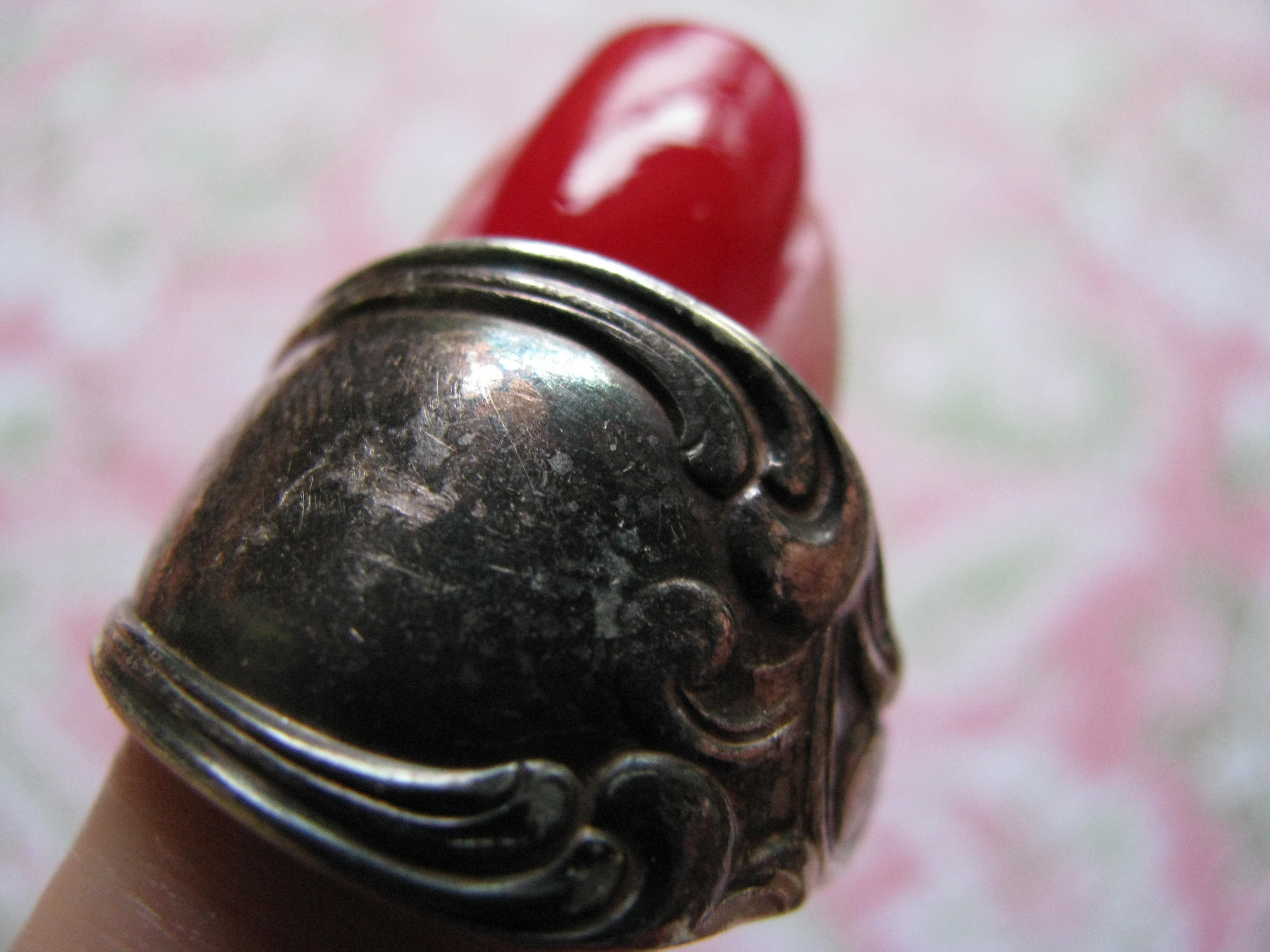
So for my "clean" prong of my "4 Cs" productive stay-at-home day, I dipped it in a silver cleaning solution for 10 seconds.

I love the ring's wide style and the ornate carvings, but it's the history of the silverware used to make the ring that clinched the sale for me. During my childhood, homemakers would save Betty Crocker coupons to purchase silverware. The woman who created my ring told me what year that this particular silverware pattern was offered through the Betty Crocker promotions program, however I haven't run across the paper that I wrote it down on… but I will. I just remember that the year has some significance to me because it was when my parents got married, or the year I was born, or something. The following information, which offers a bit of interesting history regarding the Betty Crocker coupons, came from a 2006 Minnesota Public Radio Broadcast. (Minneapolis is the home of General Mills and the women known as Betty Crocker… her look changed through the years, so there were several.)
Betty Crocker retires her catalog William Wilcoxen, Minnesota Public Radio December 14, 2006
Friday marks the end of an era for one of Minnesota's best-known businesses. General Mills is shutting down a program that's seen generations of consumers snip and save box-top coupons. The coupons were good for discounts on silverware and other merchandise sold through the Betty Crocker catalog. Many businesses have loyalty programs, but it's likely that none has reached the hearts of devoted consumers quite like Betty Crocker points.
St. Paul, Minn. — It started with a spoon. The teaspoon tucked into boxes of Wheaties in 1931 proved so popular around Depression-era breakfast tables that consumers soon clamored for forks and knives as well. Next the company slipped paper coupons into packages of Gold Medal Flour and other General Mills brands. By the time baking mixes came along, point values were printed on the outside of the box. The growing number of kitchen and dining items wound up in a catalog and eventually made their way online.
Mark Bergen, who chairs the marketing department at the University of Minnesota's Carlson School of Management, says the Betty Crocker program was remarkable for two characteristics — its longevity and the depth of emotion it inspired among its devotees. It became more than a coupon redemption program, Bergen says, by working its way into the fabric of family life. Various aspects of the program contributed to its appeal. Its structure allowed consumer excitement to build by stages. As a coveted item was spotted in the catalog, the family point collection grew incrementally, the coupons were mailed and the long-awaited product finally arrived in the mail. There was no minimum order, meaning a table setting could be built one piece at a time as the family budget allowed. The merchandise offered, Bergen says, was of a high enough quality that people were willing to save for it over time.
While the products were nice, there was never anything pretentious or intimidating about them. After all, they came from Betty Crocker, at one point one of the most popular women in America. General Mills created Betty Crocker in 1921 and she soon gained her own radio show. Betty offered warm, reassuring responses to consumer questions, and provided recipes and helpful tips on such topics as the best way to cut a wedding cake. Minneapolis writer Susan Marks is author of the book "Finding Betty Crocker: the Secret Life of America's First Lady of Food." Marks says the Betty Crocker persona resonated with Americans — mothers, especially — looking to provide their families with some wholesomeness. For many, she says, the points program is as laden with memories and nostalgia as Betty's baking products and cookbooks. "Because it's a connection they had in the kitchen with their mother, their grandmother, and these were happy times," Marks says. "And sometimes for a lot of people those times are over. Those people are not in their lives anymore, they've passed on. And through Betty Crocker they can hold onto that. So there's a lot of emotion."
Emotions could not keep the points program alive, though. Bergen of the Carlson School says shopping patterns have changed, with home baking becoming less common. In many households, the habit of saving up for a future purchase has faded in favor of buying on credit. And, he says, the idea of clipping box tops and sending them through the mail has become old-fashioned. Most modern loyalty programs work with the swipe of a plastic card and offer rewards that change quickly, often based on popularity. General Mills tried to give collectors of any discontinued silverware pattern two years notice so they could finish building their collection. The company is continuing its Box Tops for Education program, which helps schools pay for educational supplies.
And the other 3 prongs of my "4 Cs"… Cook: I tried a recipe for April's cupcake. (I already have March's cupcake planned.) Craft and Clerical Combo: I designed a postcard, printed off one for each of my five grandkids, and wrote a note on the flipside to drop in tomorrow's mail. I will share the postcard design with you tomorrow, since today's post was quite lengthy. I'm so happy with how they turned out.
Feb. 19, 2009
Today's mileage: The day slipped away from me, so my walk didn't happen.
Total monthly mileage: 48.25 miles… same as yesterday
Bible reading? Continued to read about Moses.
 Whiteley Creek Homestead

Leave a comment